 |
|
Cause : A previous program installation created pending file operations on the installation machine. |
|
Solution: 1. Go Registry path "Open HKEY_LOCAL_MACHINE\SYSTEM\CurrentControlSet\Control\Session Manager". |
 |
|
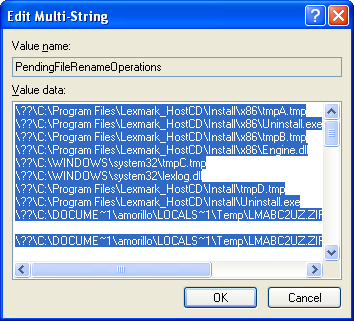
2. Double click "PendingFileRenameOperations"
|
 |
|
3. Press the key "Delete" on your keyboard.
|
 |
|
4. Press OK and close the registry. |
| 5. Try now to run SQL Server 2008 setup |
Tuesday, December 16, 2014
Restart Computer rule falied
While installing sql server 2008 you might get error: Restart Computer Failed

Tuesday, August 19, 2014
List of valid and Invalid special characters for URL.
| Character | Purpose in URL | Encoding |
|---|---|---|
| : | Separate protocol (http) from address | %3A |
| / | Separate domain and directories | %2F |
| # | Separate anchors | %23 |
| ? | Separate query string | %3F |
| & | Separate query elements | %24 |
| @ | Separate username and password from domain | %40 |
| % | Indicates an encoded character | %25 |
| + | Indicates a space | %2B |
| <space> | Invalid in URLs | %20 or + |
| ; | Invalid in URLs | %3B |
| = | Invalid in URLs | $3D |
| $ | Invalid in URLs | %26 |
| , | Invalid in URLs | %2C |
| < | Invalid in URLs | %3C |
| > | Invalid in URLs | %3E |
| ~ | Invalid in URLs | %25 |
| ^ | Invalid in URLs | %5E |
| ` | Invalid in URLs | %60 |
| \ | Invalid in URLs | %5C |
| [ | Invalid in URLs | %5B |
| ] | Invalid in URLs | %5D |
| { | Invalid in URLs | %7B |
| } | Invalid in URLs | %7D |
| | | Invalid in URLs | %7C |
| " | Invalid in URLs | %22 |
Thursday, August 14, 2014
How to remove Cache and Buffers in MS SQL Server
To remove procedure/TSQL cache and buffers execute below queries.
DBCC FREEPROCCACHE
DBCC DROPCLEANBUFFERS
DBCC FREEPROCCACHE
DBCC DROPCLEANBUFFERS
Thursday, January 23, 2014
How to rename a column name or table name in sql
1. You can rename column name as below:
sp_Rename 'tblusers.Name' , 'UserName', 'column'
2. Using below sql statement you can change object name ( table name, stored procedure name..etc)
sp_Rename 'tblusers', 'tblGlobalUsers'
sp_Rename 'tblusers.Name' , 'UserName', 'column'
2. Using below sql statement you can change object name ( table name, stored procedure name..etc)
sp_Rename 'tblusers', 'tblGlobalUsers'
Friday, January 17, 2014
how to delete top n records using sql delete statement?
DELETE top (n) FROM Table1
Note : This statement will work in sql server 2005 and above but for below version use following sql statement
DELETE tbl FROM (Select Top n * FROM Table1 ) tbl
Note : This statement will work in sql server 2005 and above but for below version use following sql statement
DELETE tbl FROM (Select Top n * FROM Table1 ) tbl
Sunday, June 16, 2013
How to delete referential records from a sql table?
If there is a foreign key relationship between two table then you can not delete a record which is referenced by another table.
Solution:
Use On DELETE CASCADE
Example:
Alter Table Employee
DROP Constraint FK_Employee_Department
GO
ALTER Table Employee
Add Constraint FK_Employee_Department Foreign key (DeptID)
References Department(id)
On DElete Cascade
Note: If you delete a record from department table then all the associated records from Employee will be deleted.
Solution:
Use On DELETE CASCADE
Example:
Alter Table Employee
DROP Constraint FK_Employee_Department
GO
ALTER Table Employee
Add Constraint FK_Employee_Department Foreign key (DeptID)
References Department(id)
On DElete Cascade
Note: If you delete a record from department table then all the associated records from Employee will be deleted.
How to find missing Identity id from a sql table?
Below is the sql statement to find the missing identity Id from sql table '#tmp1'
'#tmp1' content
SQL Statement
With missing as
(
Select 1 as mins, max(Id) as maxs from #tmp1
UNION ALL
Select mins + 1 , maxs from missing m
--Inner join #tmp1 t ON t.ID = m.mins
where mins < maxs
)
Select * from missing m
left outer join #tmp1 t ON t.ID = m.mins
where t.Id is null
Missing Identity
'#tmp1' content
| ID | Name |
| 1 | Arvind |
| 2 | Kapil |
| 5 | Mohit |
| 8 | Rakesh |
SQL Statement
With missing as
(
Select 1 as mins, max(Id) as maxs from #tmp1
UNION ALL
Select mins + 1 , maxs from missing m
--Inner join #tmp1 t ON t.ID = m.mins
where mins < maxs
)
Select * from missing m
left outer join #tmp1 t ON t.ID = m.mins
where t.Id is null
Missing Identity
| ID | Name |
| 3 | Raj |
| 4 | Mangesh |
| 6 | Rajesh |
| 7 | Ravindra |
Subscribe to:
Posts (Atom)